| 1. Decal Printing (On-Glaze Decal / Under-Glaze Decal) |
Glass-specific glaze (containing pigments) is printed on the glass surface and sintered at a high temperature of 500-600℃ to fuse the glaze with the glass. (Under-Glaze Decal requires printing before glass forming; On-Glaze Decal is applied after forming.) |
1. Exceptional durability: The glaze fuses with the glass, ensuring resistance to friction, water washing (dishwasher-safe), and high temperatures (suitable for holding hot water/hot drinks);
2. Stable color: Pigments do not fade easily after high-temperature curing, with no risk of peeling during long-term use;
3. High safety: Glass-specific glazes can meet food-grade standards (especially Under-Glaze Decal, which eliminates the risk of pigment contact with food). |
1. Complex process: Requires high-temperature kilns, leading to high equipment costs and low cost-effectiveness for small-batch production;
2. Low flexibility: Patterns cannot be modified after sintering, resulting in a high rejection rate;
3. Limited precision: Cannot achieve ultra-small text or complex gradient patterns (glaze tends to spread at high temperatures). |
Household heat-resistant glass cups (e.g., mugs, inner liners of insulated cups), food-contact glassware (e.g., tableware), and practical glass cups for long-term use (e.g., hotel-specific cups). |
| 2. UV Printing (Digital UV Printing) |
UV-curable ink is directly sprayed onto the glass surface via a digital printer and instantly cured by UV lamp irradiation (no high temperature required). |
1. High precision: Enables high-definition patterns (e.g., photo-quality images), gradients, and complex textures, with no "screen texture" typical of Screen Printing;
2. High flexibility: Supports small-batch customization (even single-cup printing) and pattern modifications without plate replacement, ideal for personalized needs;
3. High efficiency: Printing + curing is fast (completed in seconds), with no need for prolonged high-temperature sintering;
4. Curved surface adaptation: Some UV printers support printing on slightly curved surfaces (e.g., glass cups with small-radius bodies). |
1. Weak adhesion: Ink only adheres to the glass surface via UV curing (no fusion with glass), so it easily peels off after long-term friction or water washing (especially on frequently touched areas like cup rims or bodies);
2. Poor heat resistance: UV ink has low heat resistance (usually <100℃) and cannot hold boiling water or be used in microwaves;
3. High cost: UV ink is expensive, and unit costs for small-batch production are higher than Screen Printing. |
Personalized custom glass cups (e.g., cups printed with photos or exclusive text), decorative cups for short-term use (e.g., gift cups, exhibition cups), and decorations on non-food-contact parts (e.g., patterns on the outer surface of cups, no printing on cup rims). |
| 3. Screen Printing |
Glass-specific ink is scraped onto the glass surface through a silk screen stencil (with hollowed-out pattern areas) and cured by low-temperature drying (80-150℃). |
1. Low cost for mass production: Stencils can be reused, ink usage is controllable, making it suitable for large-batch production (e.g., affordable decorative cups in supermarkets);
2. Strong ink adaptability: Food-grade ink (for cup rims) or heat-resistant ink (for cup bodies) can be selected to meet different needs;
3. Vivid colors: The ink layer is thicker (thicker than UV Printing), providing strong color coverage (suitable for printing light colors on dark glass). |
1. Low precision: Limited by screen mesh count, it cannot achieve ultra-small text (<2mm, prone to blurring) or gradient patterns (multi-color overprinting is required, leading to easy misalignment);
2. Poor curved surface adaptation: Only suitable for flat or slightly curved surfaces (e.g., cup bottoms, straight sections of cup bodies); cups with large curved bodies often suffer from "missing prints" or "scratches";
3. Low cost-effectiveness for small batches: Screen stencils require separate mold making, so costs for small batches (<100 units) are higher than UV Printing. |
Large-batch decorative glass cups (e.g., cartoon cups, promotional gift cups), simple logo printing on glassware (e.g., brand logos), and flat glass components (e.g., cup lids, coasters). |
| 4. Laser (Etching / Marking) |
A high-energy laser beam acts on the glass surface:
- Etching: Burns/abrades the glass surface to form recessed patterns;
- Marking: Alters the molecular structure of the glass surface to form "color-changing marks" (no recess, only color variation). |
1. Eco-friendly with no consumables: No ink/glaze is used, and there is no chemical residue, making it suitable for food-contact parts (e.g., engraving on cup rims);
2. Ultra-high precision: Can engrave ultra-small text (<1mm) and complex lines (e.g., QR codes, fine patterns) with smooth edges;
3. Strong durability: Etching/marking involves physical/chemical changes to the glass surface, eliminating the risk of "coating peeling" and ensuring resistance to friction and water washing. |
1. Weak decorative effect: Only "single-color effects" are possible (etching produces transparent/white recesses; marking mostly creates light brown/gray marks), and colored patterns cannot be printed;
2. High cost: Laser equipment is expensive (especially deep-etching equipment), and unit costs for small-batch processing are higher than UV Printing;
3. Limited depth: Etching depth is usually <0.2mm (deep etching easily causes glass cracking), resulting in weaker three-dimensionality than chemical etching. |
Personalized engraving on glass cups (e.g., names, anniversaries), marking on glassware (e.g., product numbers, material descriptions), and fine functional patterns (e.g., anti-slip patterns on cup bottoms, scale lines on cup bodies). |
| 5. Hot Stamping (Heat Transfer Stamping) |
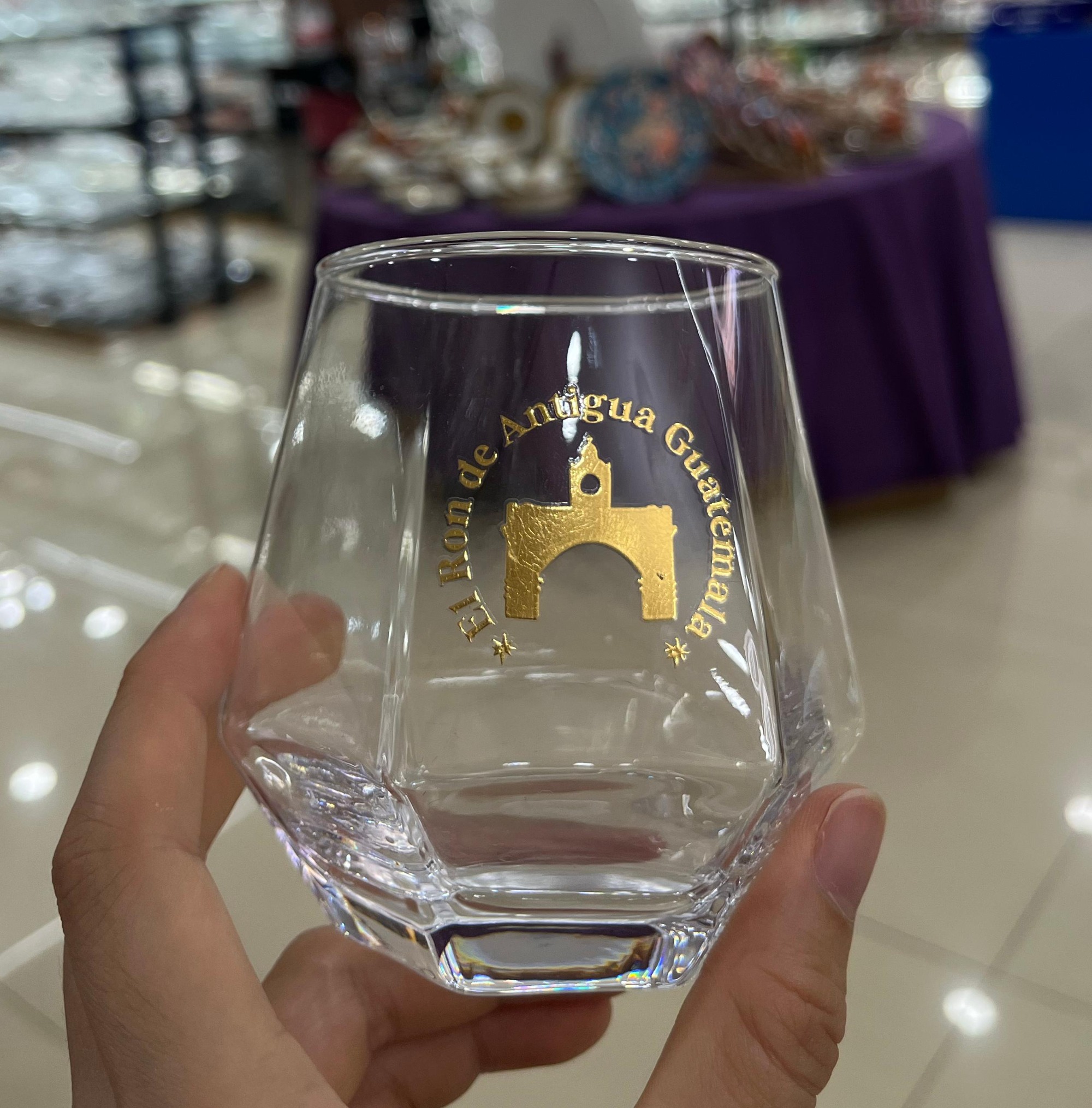
Metal foil (gold/silver/laser foil) is transferred onto the glass surface via high temperature (120-180℃), high pressure, and a stamping plate to form metallic patterns. |
1. Premium texture: Metal foil (especially real gold foil and silver foil) has strong gloss, offering a more high-end look than printing (suitable for high-end gift cups);
2. Concise and exquisite patterns: Ideal for simple lines, logos, borders, and text (e.g., gold-stamped logos on "VIP customized cups");
3. No ink residue: Only metal foil is transferred, making it safer than some printing processes (food-grade foil must be selected). |
1. Weak adhesion: Metal foil adheres only via hot-melt adhesive, so it easily peels off after long-term friction or water washing (especially in humid environments);
2. Narrow application range: Only suitable for flat or slightly curved surfaces (stamping plates are rigid, leading to "incomplete stamping" on curved surfaces); large-area patterns (>10cm²) are prone to wrinkling;
3. Limited colors: Mainly gold, silver, and laser colors; no colored or gradient effects can be achieved. |
High-end gift glass cups (e.g., business gifts, holiday gift sets), partial decorative accents on glass cups (e.g., gold-stamped logos on cup bodies, gold-stamped edges on cup rims), and glassware for short-term display (e.g., exhibition sample cups). |


 29August 2025
0Comments
482Views
29August 2025
0Comments
482Views